Right-Sided Gauß Test
Also known as the sellers perspective. This test is used to accept H 0 H_0 H 0 Test Statistic attains values typical for H 0 H_0 H 0
H 0 : μ < μ 0 H_0:\mu<\mu_0 H 0 : μ < μ 0 H 1 : μ ≥ μ 0 H_1:\mu\geq\mu_0 H 1 : μ ≥ μ 0
Acceptance Domain I = ( − ∞ , z 1 − α ] I=(-\infty,z_{1-\alpha}] I = ( − ∞ , z 1 − α ]
t ∈ ( − ∞ , z 1 − α ] ⟺ α ≤ 1 − Φ ( t ) t \in\left(-\infty, z_{1-\alpha}\right] \Longleftrightarrow \alpha \leq 1-\Phi(t) t ∈ ( − ∞ , z 1 − α ] ⟺ α ≤ 1 − Φ ( t )
t ∈ ( − ∞ , z 1 − α ] ⟺ μ 0 ≥ x ˉ − z 1 − α σ n t \in\left(-\infty, z_1-\alpha\right] \Longleftrightarrow \mu_0 \geq \bar{x}-z_{1-\alpha} \frac{\sigma}{\sqrt{n}} t ∈ ( − ∞ , z 1 − α ] ⟺ μ 0 ≥ x ˉ − z 1 − α n σ
Errors
The Type 1 Error is also called "embarrassing error" which we want to minimize:
P μ ( reject H 0 ) = P μ ( T n > z 1 − α ) = 1 − Φ λ ( z 1 − α ) < 1 − Φ 0 ( z 1 − α ) = 1 − ( 1 − α ) = α ( μ ∈ H 0 ) \begin{aligned}
\mathbb{P}_{\mu}\left(\text { reject } H_{0}\right) &=\mathbb{P}_{\mu}\left(T_{n}>z_{1-\alpha}\right)=1-\Phi_{\lambda}\left(z_{1-\alpha}\right) \\
&<1-\Phi_{0}\left(z_{1-\alpha}\right)=1-(1-\alpha)=\alpha \quad\left(\mu \in H_{0}\right)
\end{aligned} P μ ( reject H 0 ) = P μ ( T n > z 1 − α ) = 1 − Φ λ ( z 1 − α ) < 1 − Φ 0 ( z 1 − α ) = 1 − ( 1 − α ) = α ( μ ∈ H 0 ) The Type 2 Error can get large as it would be ok:
β ( μ ) = P μ ( accept H 0 ) = Φ λ ( z 1 − α ) ( μ ∈ H 1 ) \beta(\mu)=\mathbb{P}_\mu\left(\operatorname{accept} H_0\right)=\Phi_\lambda\left(z_{1-\alpha}\right) \quad\left(\mu \in H_1\right) β ( μ ) = P μ ( accept H 0 ) = Φ λ ( z 1 − α ) ( μ ∈ H 1 ) Both errors depend on the μ \mu μ
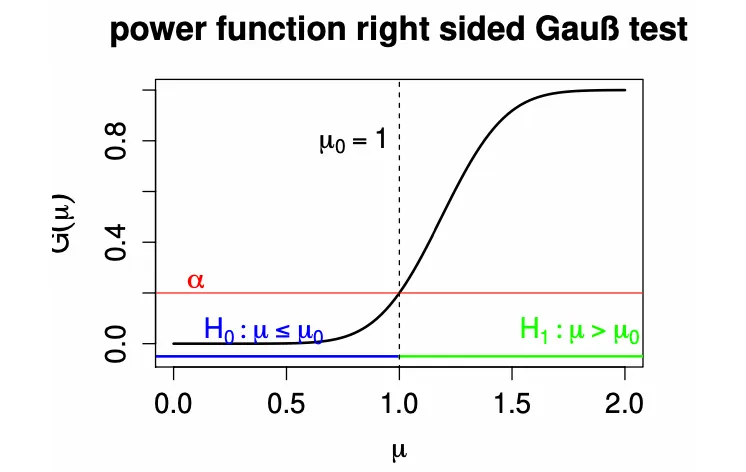
Power Function
The Power Function is:
G ( μ ) = 1 − Φ λ ( z 1 − α ) = Φ − λ ( z α ) G(\mu)=1-\Phi_\lambda\left(z_{1-\alpha}\right)=\Phi_{-\lambda}\left(z_\alpha\right) G ( μ ) = 1 − Φ λ ( z 1 − α ) = Φ − λ ( z α )
Similar to the Left-Sided Gauß Test important statements can be generated from the power function curve.